Remote ID Pro
Attaches to any drone and broadcasts to EU and US standards simultaneously. No subscription required.

Made in Denmark
2.950 DKK / 395 EUR excl. taxes
Remote ID Pro is an attachable module from AirPlate that makes any drone, from any manufacturer, compliant with the EU Direct Remote ID requirement. It combines broadcast and network Remote ID in one device, needs no subscription, and attaches with the Velcro strip provided in the box.
What it does

Broadcast Remote ID
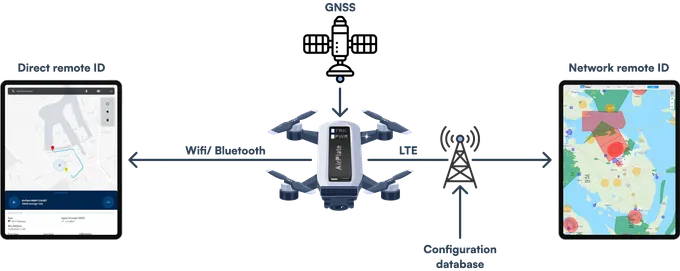
Transmits Bluetooth 5 or Wi-Fi Beacon signals to satisfy broadcast and direct Remote ID requirements.

Network Remote ID
LTE-connected and 5G-ready. Flight data uploads to the AirPlate platform via the included SIM.

10-year SIM included
Worldwide data SIM valid for 10 years. No subscription, no manual setup. Works from first power-on.

Dual-standard compliance
Certified against EU prEN 4709-002 and US ASTM F3411-22a. One device covers both markets.

OTA firmware updates
AirPlate pushes firmware updates automatically over the air. No cables, no downtime.

Flexible power
Runs on the drone's power supply or its own internal battery.

Dashboard configuration
Configure device settings and review flight activity directly from your AirPlate account.

Fleet management
Track flight hours and pilot activity across your entire drone fleet in one place.

Automatic logbook
Every flight is logged and timestamped. Meets Danish drone legislation requirements without manual input.
How it works
Broadcast and network Remote ID in one device.
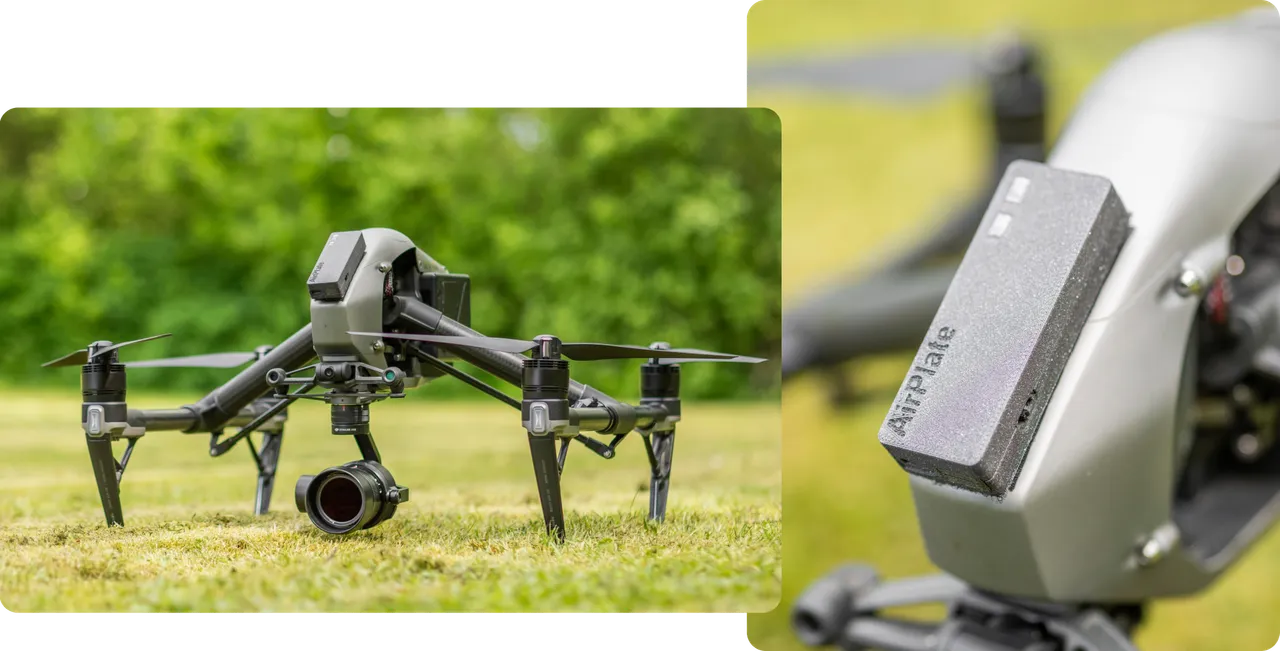
Attaching the Remote ID Pro
to Your Drone
You can easily attach the Remote ID Pro to your drone using your preferred method. We recommend using a Velcro strip provided in the box.
Unlock the Full Potential of Your Drone, Subscription-Free
The Remote ID Pro integrates Remote ID, dashboard analytics, and geo-awareness for streamlined compliance and flight management.
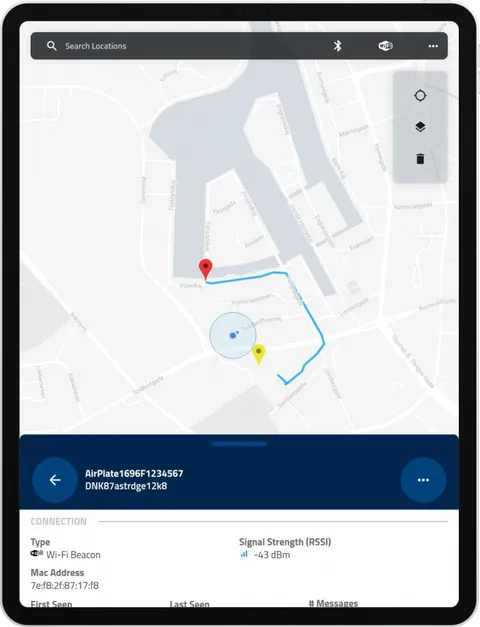
Remote ID
The Remote ID Pro meets Direct/Broadcast Remote ID requirements, enabling public and authorities to access drone operator details via smartphones, ensuring compliance with EASA and FAA regulations.
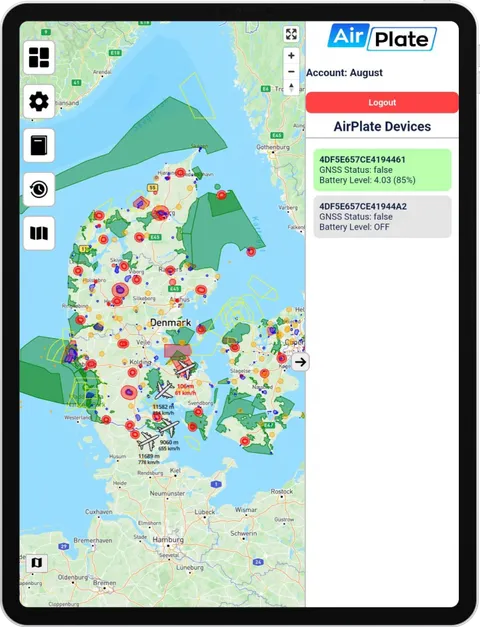
Dashboard
Our fleet management system streamlines the setup and tracking of Remote ID Pros, drones, and pilots. It allows easy Remote ID Pro configuration and flight history viewing, with all key details at your fingertips.
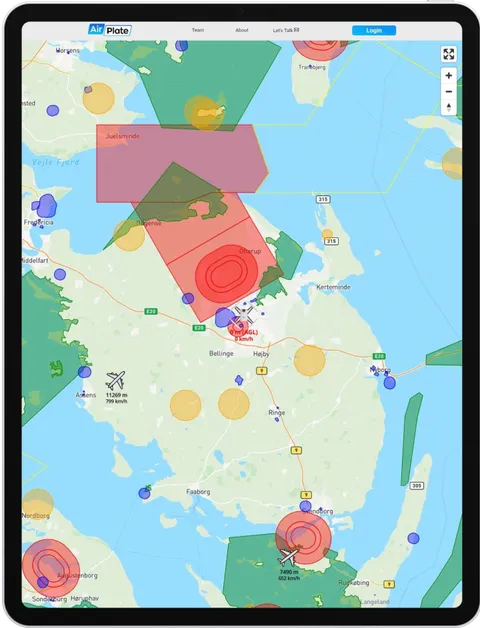
AirMap
The Remote ID Pro features Network Remote ID, displayed on the AirMap for real-time tracking of drones and aviation activities. It highlights drones, airplanes, flight zones, and NOTAMs with restrictions for geo-awareness.
Supported regions
and countries

European Union
The Remote ID Pro complies with EASA’s requirements of Direct Remote Identification from (EU) 2019/945 in according to the ASD-STAN prEN 4709-002 standard. All new drones weighing over 249 grams or flying the Open Subcategory A2. It also required for all drones in the Specific category. The Remote ID Pro is also U-Space Ready with its Network Remote ID capability.

North America
The Remote ID Pro meets the requirements for Broadcast Remote ID by Federal Aviation Administration (FAA) and is compliant with the ASTM F3411-22a standard. Broadcast Remote ID is required by all drones weighing between 0.55 pounds and 55 pounds in the US.

Worldwide
The Remote ID Pro can be used worldwide with Direct/Broadcast Remote ID once it is configured in a country with coverage. The Remote ID Pro supports all countries that use ASD-STAN (EU) or ASTM (US) standards. The Network Remote ID functionality depends on the country and coverage. A list of supported countries is provided in the documentation.
Specifications
Connectivity
LTE · 5G ready
Broadcast
Bluetooth 5 · Wi-Fi Beacon
SIM validity
10 years · worldwide
Standards
EU prEN 4709-002 · US ASTM F3411-22a
Power
Internal battery or drone-powered
Firmware
Over-the-air updates
Logbook
Automatic · Danish legislation ready
Price
2.950 DKK · no subscription
Frequently Asked
Questions
Why do I need Remote ID
+The European Union Aviation Safety Agency (EASA) released new regulations in order to increase the safety and transparency of Drone operations. Drones that are manufactured after January 1st, 2024, must obtain the C-certification (must have a license plate) in order to fly in the A2 subcategory (> 250 grams). It is necessary to have this C-certification, otherwise all drones between 250 grams and 25 kg will have to fly in subcategory A3.
How do I know what kind of requirements my drone should meet?
+Start by identifying the type of drone you have, find the subcategory of the drone and the appropriate requirements. You can do so by checking the tables on the EASA website (https://www.easa.europa.eu/en/domains/civil-drones-rpas/open-category-civil-drones)
What is Remote Identification? Why do I need it?
+From January 2024, drone operations within the EU require that almost all open-category aircraft should have an installed drone remote identification system. The direct remote Identification is the transmission of the Operator ID through Bluetooth or Wifi. This allows the public and authorities to know the number of the drone operators at all times. Because drones can be small, high up or far away, just having a number is not sufficient to identify them easily. This is why the need for a simple digital way arises to access this information through an app on a smartphone or other devices.
What is the difference between specific- and open category?
+The specific category stands for riskier operation that are not covered under the open category. In the specific category, you must submit a declaration for a standard scenario or apply for an operational authorization to the NAA Member State where you are registered. For the open category you must register with the National Aviation Authority (NAA) of the EU country where you intend to fly your drone. The registration number issued by the NAA must be displayed with a sticker on all of your operating drones and then upload it into the Remote Identification system of your drone. Moreover, the open category is split up into three additional subcategories, which bring additional rules. The subcategory determination is based on the class identification label and weight of the drone.
What is the difference between Direct Remote ID and Network Remote ID?
+Besides Direct Remote ID, there is the network remote ID where the drone can send real-time information directly to UTM (Unmanned Aircraft System Traffic Management) using mobile internet. Network ID is appropriate for advanced operation such as BVLOS flights, drone deliveries, and a combination of manned and unmanned traffic in the same airspace.
What are the limitations of drone battery life and flight range?
+The maximum distance a drone can fly is influenced by factors like battery capacity and legal restrictions, with consumer drones typically ranging from 0.25 to 4.5 miles. Drone flight range is affected by battery size, drone weight, and environmental conditions. Drones with larger battery capacities can typically fly longer distances. Smaller and lighter drones tend to have shorter ranges compared to larger and heavier ones. This is because smaller drones have less space to accommodate larger batteries, which limits their flight time and range.
Get started
Remote ID Pro is available now.
Get in touch for pricing, volume orders, or technical questions.